Sri Lanka Situation
Dengue was first serologically confirmed in Sri Lanka in 1962, and the first documented dengue outbreak was reported in 1965. During the period from 1965 to 1968, an island-wide epidemic caused by DENV-1 and DENV-2 serotypes resulted in 51 reported cases and 15 deaths.
Although dengue infections continued to occur intermittently during the 1970s and 1980s, severe dengue and dengue haemorrhagic fever (DHF) were relatively uncommon before 1989. Since 1989, Sri Lanka has experienced regular dengue epidemics with increasing magnitude, geographical spread, and disease severity. The emergence of new dengue virus genotypes and shifts in circulating serotypes have been associated with several major outbreaks in the country.
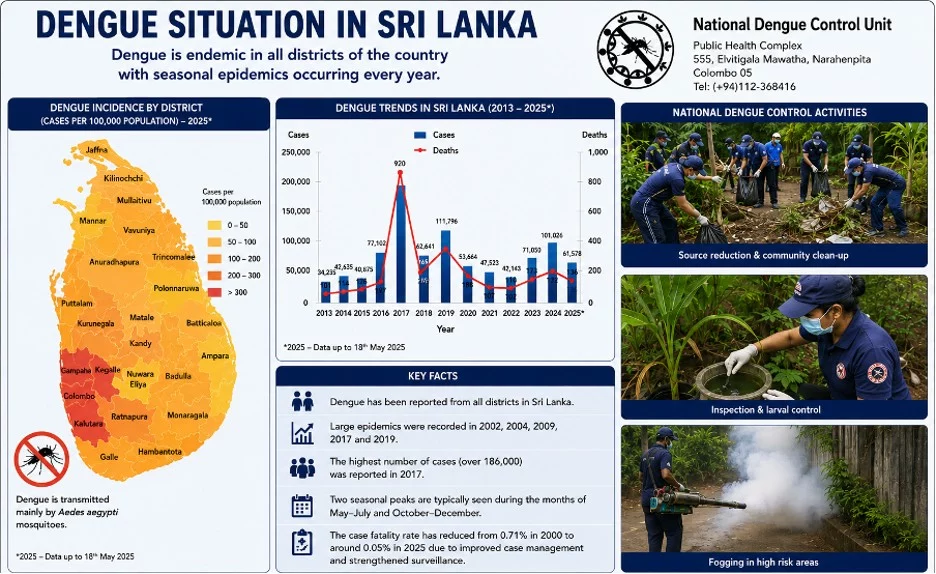
From the early 2000s onward, dengue became firmly established as an endemic disease in Sri Lanka, with cases reported from all districts of the country. Large epidemics were recorded in 2002, 2004, 2009, 2017, and 2019. The largest outbreak in Sri Lankan history occurred in 2017, with more than 186,000 reported dengue cases nationally.
The Western Province, particularly the Colombo, Gampaha, and Kalutara districts, has consistently reported the highest dengue burden in the country due to high population density, rapid urbanization, construction activities, environmental conditions favorable for mosquito breeding, and increased human mobility. Dengue transmission in Sri Lanka demonstrates a clear seasonal pattern, with two annual peaks corresponding to the southwest and northeast monsoon periods.
In response to the increasing burden of dengue, the Dengue Control Unit was established in 2005 under the Ministry of Health and was subsequently upgraded to the National Dengue Control Unit (NDCU) in 2012 to strengthen national coordination of dengue prevention and control activities.
Sri Lanka currently implements a comprehensive and integrated dengue prevention and control programme focusing on disease surveillance, entomological surveillance, laboratory surveillance, vector control, outbreak preparedness and response, risk communication, community engagement, intersectoral collaboration, and clinical management. The country utilizes real-time web-based dengue surveillance systems and conducts regular vector monitoring activities to identify high-risk areas and guide control measures.
Over the years, Sri Lanka has achieved significant improvements in dengue case management and mortality reduction. The national dengue case fatality rate has progressively declined from approximately 0.71% in 2000 to around 0.05% in recent years through strengthened clinical management, healthcare capacity building, dengue death review mechanisms, public awareness programmes, and enhanced surveillance systems.
The National Strategic Plan for Prevention and Control of Dengue 2024–2030 currently guides the country’s efforts toward reducing dengue morbidity and achieving zero dengue-related mortality in Sri Lanka by 2030.